Our lab currently has several ongoing research projects in electrochemical water and wastewater treatment.
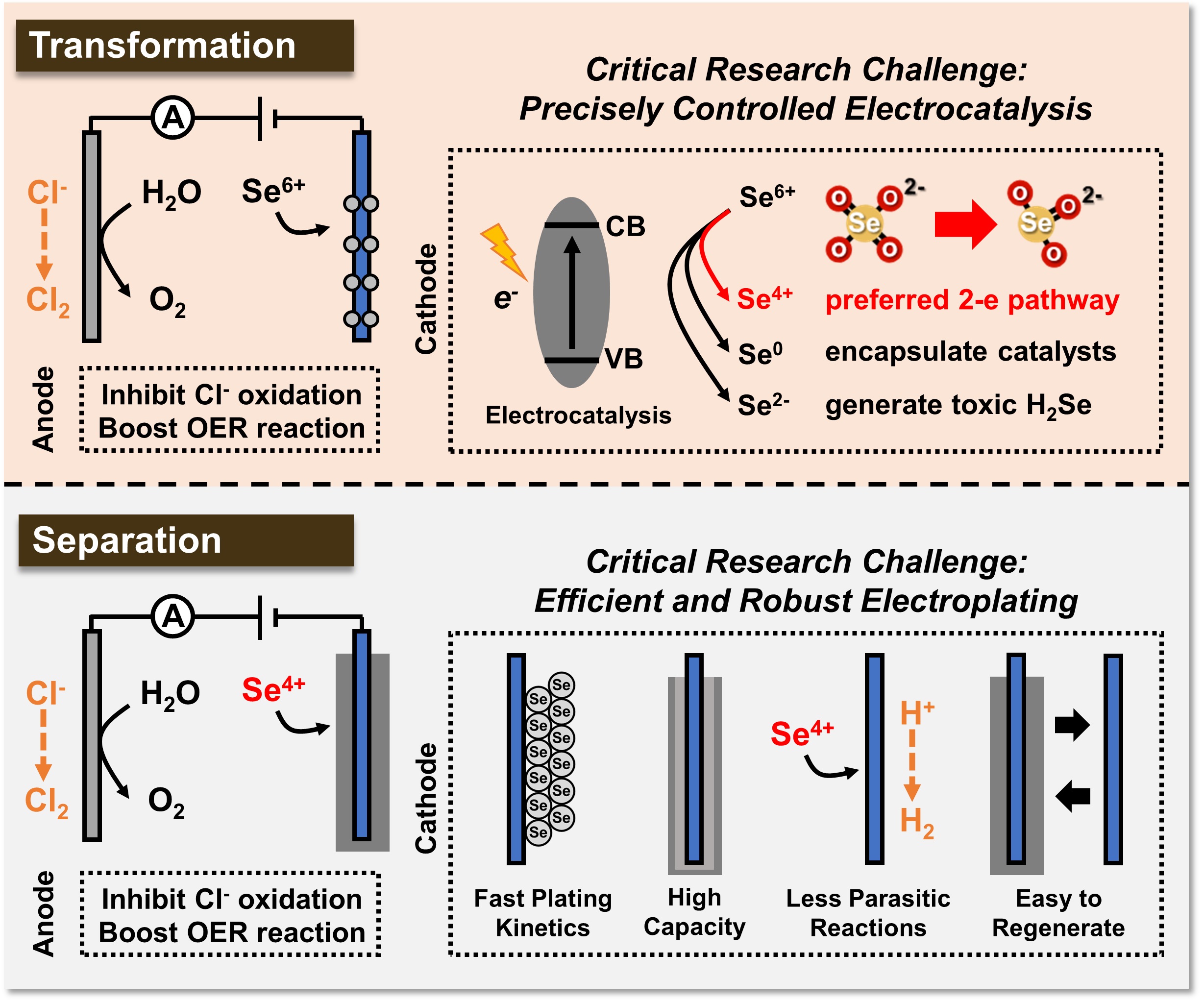
Project 1. Selenium Removal via Direct Electrochemical Reduction
Funding Agency: Department of Energy (DOE) National Alliance for Water Innovation (NAWI)

Aquatic selenium (Se) pollution is closely associated with mining, agricultural irrigation, hydraulic fracturing, and thermoelectric power generation and is typically discharged into the aquatic environment at a ppb to ppm level as Se(IV) and Se(VI) oxyanions (e.g., SeO32- and SeO42-). To effectively mitigate aquatic Se pollution, more than 30 full-scale biological and physicochemical Se treatment processes have been implemented in North America between 2007 and 2018. Disadvantages of existing solutions include: a large footprint, constant chemical dosing, susceptibility to performance upsets, the potential to generate toxic hydrogen selenide and organic Se species with significantly higher bioavailability (2-3 orders of magnitude) and toxicity than inorganic Se, high costs, and generating large amounts of (bio)solids that require further management and may cause secondary pollution. The development of next-generation treatment systems that can precisely separate Se from complex waste streams and overcome existing challenges, may enable pipe-parity and the reuse of waters traditionally considered waste streams.
Project Team at Auburn: Zilan YANG, Dr. Ao XIE
Selected Publications:
- Zou, S., & Mauter, M. S. (2021). Direct electrochemical pathways for selenium reduction in aqueous solutions. ACS Sustainable Chemistry & Engineering, 9(5), 2027-2036.
- Zou, S., & Mauter, M. S. (2021). Competing Ion Behavior in Direct Electrochemical Selenite Reduction. ACS ES&T Engineering, 1(6), 1028-1035.
- Yang, Z., Zhao, J., Sullivan, E.G., Zou, S. (2023) Cost-effective cathode materials to electrochemically tackle aquatic selenite pollution. ACS ES&T Engineering, 3 (4), 458-466.
- Xie, A., Martinez-Vargas, D.R., Yang, Z., Zou, S. (2024) Efficient selenate removal from impaired waters with TiO2-assisted electrocatalysis. Water Research, 262, 122134.
- Hao, S., Feng, Y., Wang, D., Cho, J., Qiu, C., Wi, TU., Xu, Z., Sellers, C., Zou, S., Jain, A., Wang, H. (2025) Electrochemical Removal of Se(IV) from Wastewater Using RuO2-Based Catalysts. Nano Letters, In Press.
Project 2. Electrodialysis System to Manage Inland Reverse Osmosis Concentrate
Funding Agency: Department of Energy (DOE) National Alliance for Water Innovation (NAWI)
Reverse Osmosis Concentrate (ROC), which is the waste brine produced from reverse osmosis (RO), often contains contaminants such as pesticides, boron, heavy metals, and polyfluoroalkyl substances (PFAS) compounds—which are human-made chemicals used in a wide range of consumer and industrial products. This project will develop a novel Flow-through Intensified ELectroDialysis (FIELD) treatment system that integrates three electrochemical treatment processes: electroosmosis, electrophoresis, and electrodialysis. The proposed FIELD system will degrade persistent organics (like agrochemicals, pesticides, and pharmaceuticals); capture diluted heavy metals, extract non-hazardous soluble salts for potential environmental discharge; and produce freshwater for reuse.
Project Team at Auburn: Jason ZHAO, Dr. David Martínez-Vargas
Selected Publications:
- Under Preparation.
Project 3. Electrochemical Phosphorus Removal from Runoff
Funding Agency: U.S. Environmental Protection Agency (EPA) Gulf of Mexico Division

The overarching goal of this project is to develop and demonstrate a novel geotextile and evaluate its efficacy in removing P from urban stormwater runoffs. This interdisciplinary collaboration among environmental, stormwater, and construction engineering experts, Dr. Shiqiang (Nick) Zou and Dr. Michael Perez, encompasses a comprehensive multi-year research approach. It involves designing and constructing field testing structures, developing standardized protocols for geotextile demonstration and water quality assessment, and conducting comparative analyses against commercial and modified geotextile. Its ultimate aim, to protect the Gulf Coast ecosystem through enhanced stormwater management, highlights a far-reaching societal impact that positions it at the forefront of innovative solutions for sustainable water quality improvement.
Project Team at Auburn: Jiagen GENG, Aline Christine BERNEGOSSI
Selected Publications:
- Soon to be released.
Project 4. Direct Electrochemical PFAS Destruction for In Situ Regeneration of Spent Granular Activated Carbon
Funding Agency: Department of Defense (DOD) Strategic Environmental Research and Development Program (SERDP)

This research project focuses on developing an electrochemical approach to degrade contaminants adsorbed onto filtration media, enabling in-situ regeneration under ambient conditions. The fundamental principles of this method have shown promise in transforming persistent organic pollutants, and our proof-of-concept study aims to refine electrochemical processes for more effective contaminant destruction. The project explores the hypothesis that using electrochemically stable non-aqueous solvents can enhance the reduction potential on the filtration media, allowing for direct electron transfer to break strong chemical bonds and effectively degrade adsorbed contaminants. Additionally, the relatively volatile nature of the solvents facilitates easy separation after treatment, enabling on-site media reuse in field applications. To investigate these concepts, our interdisciplinary research team includes experts in applied electrochemistry, filtration materials, and quantitative contaminant analysis, along with a collaborator from an affected municipality. The technical approach involves screening stable solvent systems, evaluating reaction thermodynamics, optimizing transformation kinetics, and conducting a techno-economic assessment to assess feasibility and scalability.
Project Team at Auburn: TBD.
Selected Publications:
- Soon to be released.
Project 5. Electrochemical Soil Conditioning
Funding Agency: Auburn Highway Research Center & Alabama Department of Transportation


Project Team at Auburn: Najibullah ZULFEQAR
 E-WATER Lab @ Michigan State