Skip to content

E-WATER Lab @ Michigan State

Electrified WAstewater Treatment and Element Recovery

  • Twitter
  • Linkedin
  • RG
  • Web of Science
  • Google Scholar
  • Home
  • Spotlight
  • Professor
    • Principal Investigator
    • Teaching
    • Archives
      • Dissertation/Thesis
      • Invited Talk/Conferences
      • Competition/Awards
      • Experience
        • Academic Experience
        • Other Experiences
  • People
    • Current Members
    • Alumni
    • Previous Collaborators
  • Research
    • Publication
    • Lab Space and Instruments
    • Ongoing Projects
    • Concluded Projects
      • Forward Osmosis
      • Osmotic Membrane Bioreactor
      • Bioelectrochemical System
  • Contact

Day: April 16, 2019

PhDone!

Posted on April 16, 2019August 10, 2019 by nicksqzou

I finally passed my Ph.D. defense today. So now I can officially call myself Dr. Zou!

Many thanks to all my committee members, friends, and family members for their love and support through these four years!

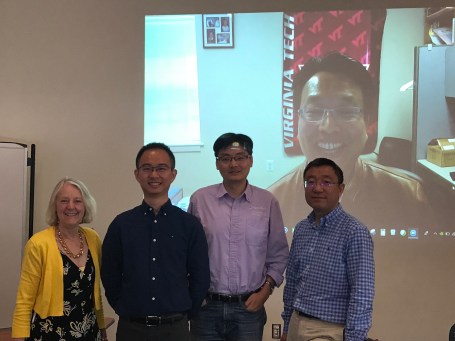
WeChat Image_20190810150933

WeChat Image_20190810150921

Posted in News & SpotlightLeave a comment

WATERJAM 2018 WITH WILLIAM RANDALL

WATERJAM 2017 With Fabrizio

WATER INTERFACE ESCAPE ROOM

AEESP 2017 with Bruce Rittmann

33RD GSA RESEACH SYMPOSIUM

WaterJAM 2016

ECi Competition 2016

32nd GSA Research Symposium

Blog Stats

  • 36,559 hits
April 2019
M T W T F S S
1234567
891011121314
15161718192021
22232425262728
2930  
« Mar   Apr »

RSS Environ. Sci. Technol.

  • [ASAP] Photosynthetic Diel Cycling Influences Inverse Zinc and Copper Solubility Dynamics within a Constructed Wetland
  • [ASAP] Energy Emissions Accounting Methods Can Determine Whether Direct Air Capture with Storage Achieves Net Removal
  • [ASAP] Nano Single-Crystal-Assembled MEL Zeolites with Specific Al Pairs for Efficient Low-Temperature Selective Catalytic Reduction of NOx by Methanol
  • [ASAP] H2O2-Driven Sulfate Formation at Air–Water Interfaces: Stepwise Mechanism and Accelerated Kinetics
  • [ASAP] Hospital Environments Harbor Chlorhexidine-Tolerant Bacteria Potentially Linked to Chlorhexidine Persistence in the Environment
  • [ASAP] Glyphosate (Roundup) Impairs Embryonic Development and Thermal Adaptation in Lizard (Eremias argus) under Warming
  • [ASAP] Organic Fertilization Promotes the Microbial Formation of Moderately Active Soil Phosphorus Pools to Sustain Phosphorus Availability: Insights from 180 years of Fertilization
  • [ASAP] Challenges and Initiatives to Operationalize the Planetary Boundaries for Novel Entities
  • [ASAP] Association between Ambient Temperature and Ventricular Arrhythmias in Patients with Implantable Cardioverter-Defibrillators: A Time-Stratified Case-Crossover Study in China
  • [ASAP] Molecular–Microbial Cascades Regulate Organic Phosphorus Mineralization in Lake Sediments

RSS Water Research

  • Species-specific salinity adaptation mechanisms drive niche partitioning of nitrite-dependent anaerobic methane oxidation bacteria in a natural wetland gradient
  • Super-Resolution enhanced deep learning for efficient and accurate urban flood simulation at the street scale
  • Unraveling the flame retardant mechanism of protein-rich matrix recovered from anaerobic sludge: The governing role of microstructural characteristics
  • Biofilm-induced microplastic transport under subcritical shear stress
  • Unveiling the dual role of ferrous ion in nitro‑antibiotic removal by zero‑valent iron: Governing parent compound removal and driving toxic intermediate accumulation
  • Microplastics in nearshore groundwater of Taihu Lake: occurrence and potential fluxes to the lake via groundwater discharge
  • Selective removal of trace 2-methylisoborneol in real waters via hydrophobic interface-driven adsorption
  • Schmutzdecke maturation and layers’ contribution to bacterial removal performance in slow sand filters for drinking water production
  • Research on the ion-extraction demulsification mechanism and fiber-particle-induced coalescence for deep oil removal from high-salinity gas-field produced water
  • Fresh-seawater interface shapes nitrogen fate in a subtropical estuary: Insights from multi-isotopic and metagenomic analyses
Create a website or blog at WordPress.com
  • Subscribe Subscribed
    • E-WATER Lab @ Michigan State
    • Already have a WordPress.com account? Log in now.
    • E-WATER Lab @ Michigan State
    • Subscribe Subscribed
    • Sign up
    • Log in
    • Report this content
    • View site in Reader
    • Manage subscriptions
    • Collapse this bar
 

Loading Comments...