Skip to content

E-WATER Lab @ Michigan State

Electrified WAstewater Treatment and Element Recovery

  • Twitter
  • Linkedin
  • RG
  • Web of Science
  • Google Scholar
  • Home
  • Spotlight
  • Professor
    • Principal Investigator
    • Teaching
    • Archives
      • Dissertation/Thesis
      • Invited Talk/Conferences
      • Competition/Awards
      • Experience
        • Academic Experience
        • Other Experiences
  • People
    • Current Members
    • Alumni
    • Previous Collaborators
  • Research
    • Publication
    • Lab Space and Instruments
    • Ongoing Projects
    • Concluded Projects
      • Forward Osmosis
      • Osmotic Membrane Bioreactor
      • Bioelectrochemical System
  • Contact

Month: January 2019

Started as a Via Teaching Scholar for CEE3104

Posted on January 28, 2019August 10, 2019 by nicksqzou

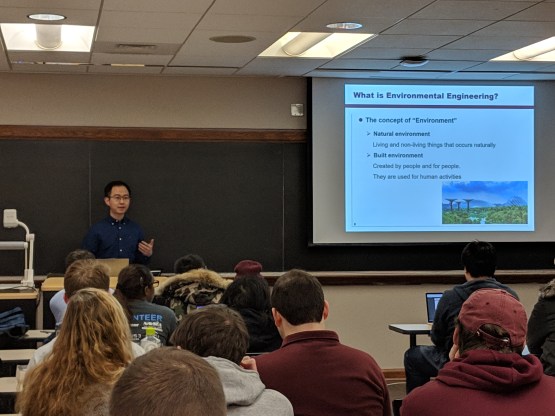
I’m appointed as a Via Teaching Scholar this semester at the Department of Civil and Environmental Engineering. Thrilled to have the opportunity to teach CEE3104 “Introduction to Environmental Engineering”! Looking forward to this journey with 38 undergrads in my class.
WeChat Image_20190810152339.jpg

Posted in News & SpotlightLeave a comment

WATERJAM 2018 WITH WILLIAM RANDALL

WATERJAM 2017 With Fabrizio

WATER INTERFACE ESCAPE ROOM

AEESP 2017 with Bruce Rittmann

33RD GSA RESEACH SYMPOSIUM

WaterJAM 2016

ECi Competition 2016

32nd GSA Research Symposium

Blog Stats

  • 36,852 hits
January 2019
M T W T F S S
 123456
78910111213
14151617181920
21222324252627
28293031  
« Jan   Mar »

RSS Environ. Sci. Technol.

  • [ASAP] Blue Carbon Vulnerability Revealed by Damming- and Eutrophication-Induced Source Shifts in River-Connected Marshes
  • [ASAP] Solid–Water–Air Interface Accelerated Photochemical Reactions in Mineral Dust Microdroplets: An Overlooked Source of Atmospheric •OH
  • [ASAP] From Maternal Exposure to Fetal Risk: Unraveling the PFAS Exposure Pathway and Its Placental Toxicity Mechanism
  • [ASAP] Mechanochemical Design of Low-Pt Zeolite Catalysts with Coupled SCO-SCR Pathways for Efficient Ammonia Emission Abatement
  • [ASAP] Thermotactic Decision-Making in Aquatic Invertebrates: High-Resolution Behavioral Analysis of Ecotoxicological Effects
  • [ASAP] Multifaceted Impacts of Organic Matter on Hydroxyl Radical Production upon Oxidation of Reduced Ferrihydrite-Organic Matter Coprecipitates
  • [ASAP] Twenty-Five Years of Research and Monitoring Using PUF Disk Passive Air Samplers
  • [ASAP] Are We Truly Accurately Quantifying HO• Using Benzoic Acid Hydroxylation in Engineered HO•-Producing Systems?
  • [ASAP] Unveiling the Dual Inhibition Mechanism of Ammonia Slip on VOC Oxidation over CeO2: From Electronic Perturbation to Byproduct Trapping
  • [ASAP] Maternal Exposure to Bisphenol A Bis(diphenyl Phosphate) Induces Offspring Colitis through Disrupting the Gut Microbiome-Metabolite Axis

RSS Water Research

  • Storage and soil depth, in addition to wastewater treatment, govern microbiota, and mobile genetic element and antibiotic resistance markers during reclaimed water irrigation
  • FIND Parallel: A parallel numerical solver for large-scale simulations of cross-scale spiral-wound reverse osmosis membrane channels
  • Side-stream fermentation drives partial denitrification/anammox for enhanced nitrogen removal and anaerobic ammonium oxidation bacteria enrichment in a flocs-based continuous-flow anaerobic/aerobic/anoxic system
  • Phage predation mitigates the spread of antibiotic resistance in anaerobic digestion under shortened solid retention times
  • A knowledge-based deep learning model for accurate urban drainage system prediction under spatiotemporally variable rainfall
  • Niche adaptation of marine heterotrophic nitrification–aerobic denitrification bacterium in mariculture wastewater treatment: Synergistic mechanism of nitrogen removal and sulfamethoxazole biotransformation
  • PFAS quantitation with diffusive gradients in thin-film passive samplers: Capturing time-weighted average concentrations around maximum contaminant levels to facilitate compliance
  • Mechanisms of aerobic simultaneous nitrogen removal under low COD/N conditions: Diffusion–reaction coupling and particle size effects via self-recirculating microgranular system
  • Metabolomics-driven Insights into chlorine-resistant mechanisms of drinking water−isolated fungal strain and an effective disinfection strategy
  • Microbial niches and metabolism drive spatial heterogeneity of hydroxyapatite precipitation in aerobic granular sludge
Create a website or blog at WordPress.com
  • Subscribe Subscribed
    • E-WATER Lab @ Michigan State
    • Already have a WordPress.com account? Log in now.
    • E-WATER Lab @ Michigan State
    • Subscribe Subscribed
    • Sign up
    • Log in
    • Report this content
    • View site in Reader
    • Manage subscriptions
    • Collapse this bar
 

Loading Comments...