Skip to content

E-WATER Lab @ Michigan State

Electrified WAstewater Treatment and Element Recovery

  • Twitter
  • Linkedin
  • RG
  • Web of Science
  • Google Scholar
  • Home
  • Spotlight
  • Professor
    • Principal Investigator
    • Teaching
    • Archives
      • Dissertation/Thesis
      • Invited Talk/Conferences
      • Competition/Awards
      • Experience
        • Academic Experience
        • Other Experiences
  • People
    • Current Members
    • Alumni
    • Previous Collaborators
  • Research
    • Publication
    • Lab Space and Instruments
    • Ongoing Projects
    • Concluded Projects
      • Forward Osmosis
      • Osmotic Membrane Bioreactor
      • Bioelectrochemical System
  • Contact

Month: January 2019

Started as a Via Teaching Scholar for CEE3104

Posted on January 28, 2019August 10, 2019 by nicksqzou

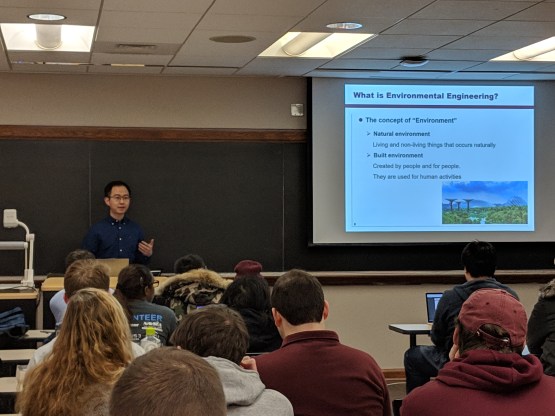
I’m appointed as a Via Teaching Scholar this semester at the Department of Civil and Environmental Engineering. Thrilled to have the opportunity to teach CEE3104 “Introduction to Environmental Engineering”! Looking forward to this journey with 38 undergrads in my class.
WeChat Image_20190810152339.jpg

Posted in News & SpotlightLeave a comment

WATERJAM 2018 WITH WILLIAM RANDALL

WATERJAM 2017 With Fabrizio

WATER INTERFACE ESCAPE ROOM

AEESP 2017 with Bruce Rittmann

33RD GSA RESEACH SYMPOSIUM

WaterJAM 2016

ECi Competition 2016

32nd GSA Research Symposium

Blog Stats

  • 34,909 hits
January 2019
M T W T F S S
 123456
78910111213
14151617181920
21222324252627
28293031  
« Jan   Mar »

RSS Environ. Sci. Technol.

  • [ASAP] Pitfalls in Probing Singlet Oxygen by Electron Paramagnetic Resonance Spectroscopy in Engineered Environmental Systems
  • [ASAP] Seeding Advanced Treated Wastewater for Purposes of Direct Potable Reuse
  • [ASAP] How do Hydrological Variability and Human Activities Control the Spatiotemporal Changes of Riverine Nitrogen Export in the Upper Mississippi River Basin?
  • [ASAP] Potassium Ferrate as a Novel Anti-Biofouling Agent for Invasive Freshwater Mussels: Multi-Omics Insights and Pilot-Scale Validation
  • [ASAP] Enhanced Formation of Brominated and Nitrogenous Disinfection Byproducts in Drinking Water Disinfection with Chlorocyanurates
  • [ASAP] Dissolved Organic Carbon Source Impact on Perfluoroalkyl Substances Removal from Stormwater Using Activated Carbon and Ion Exchange Resin
  • [ASAP] Policy Portfolio Options for Encouraging Deployment of Negative Emissions Technologies in the Electricity System
  • [ASAP] Sorption of Anionic and Zwitterionic Per- and Polyfluoroalkyl Substances Present in Legacy Aqueous Film-Forming Foams
  • [ASAP] Enhanced Manganese Oxidation at the Biofilm–Fluid Interface Drives Pore-Scale Patterns in Mineral Precipitation
  • [ASAP] Trace Ruthenium Anchored on Nickel Phosphide Steers Hydrogen Atom Transfer for Efficient Nitrate-to-Ammonia Electroreduction

RSS Water Research

  • Comment on “On-site sanitation systems and fecal contamination in shallow groundwater in urban Indonesia: assessing influence of distance and rainfall variables” By G. L. Putri, A. M. Ilmi, R. Handayani, D. Iskandar, C. R. Priadi, J. Willetts, T. Foster; Water Research Volume 287 (Part B), 20 August 2025, 124431
  • Characterization of leak flow from pipes under the effect of cavitation in water distribution systems
  • Freezing-modulated cycle of manganese species for enhanced non-radical oxidation of micropollutants in the peracetic acid/Mn(IV) system
  • Global mapping of pharmaceutical ecological risk in rivers using machine learning: drivers, hotspots, and compounded water stress
  • Exploring N-nitrosodimethylamine formation induced from water flocculants by isotope tracking and spectral analysis
  • Autochthonous particulate organic carbon drives extreme carbon fluxes in river-reservoir systems: Potential role of interactions between picophytoplankton and heterotrophic bacteria
  • Using machine learning to predict heavy metal concentrations and induced health risks in drinking water distribution systems from key cities in China
  • UV radiation reduces both organic nutrient (long-chain polyunsaturated fatty acids) and inorganic nutrient (phosphorus) of basal resources in stream food webs
  • Spatiotemporal dynamics, source and flux of dissolved black carbon in the monsoon-influenced Yangtze River system
  • Dynamic characteristics of planktonic bacterial and micro-eukaryotic communities and their response mechanisms to combined pollutants in river-reservoir system
Create a website or blog at WordPress.com
  • Subscribe Subscribed
    • E-WATER Lab @ Michigan State
    • Already have a WordPress.com account? Log in now.
    • E-WATER Lab @ Michigan State
    • Subscribe Subscribed
    • Sign up
    • Log in
    • Report this content
    • View site in Reader
    • Manage subscriptions
    • Collapse this bar
 

Loading Comments...